Aisle 3No. 46 of 460
Splashery
Bombe
630,000 small parts. Assembled in your browser.
Empty. Now look down.
Swipe across the pack to tear it open.
Press and hold. It pulls itself together.
Let go to drop it.
It stays in its pack here. The Playground has the rest.
AI and Computing · Built from a recipe
Bombe
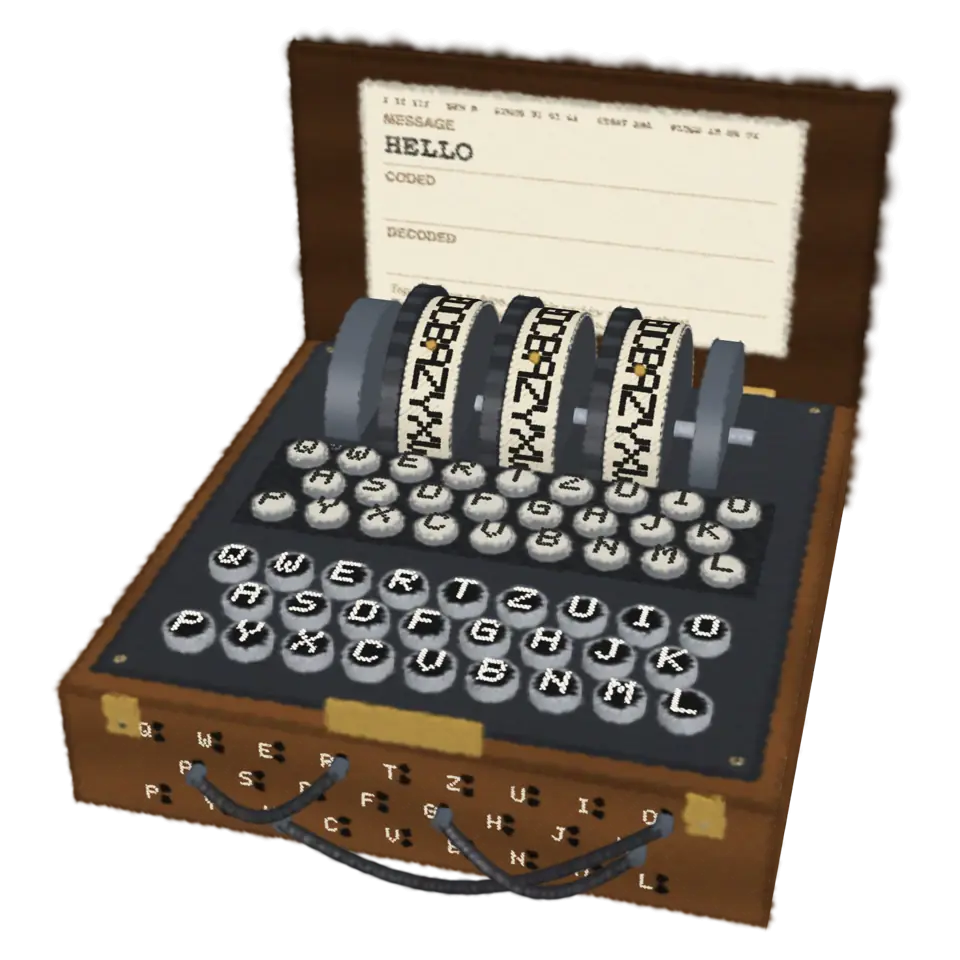
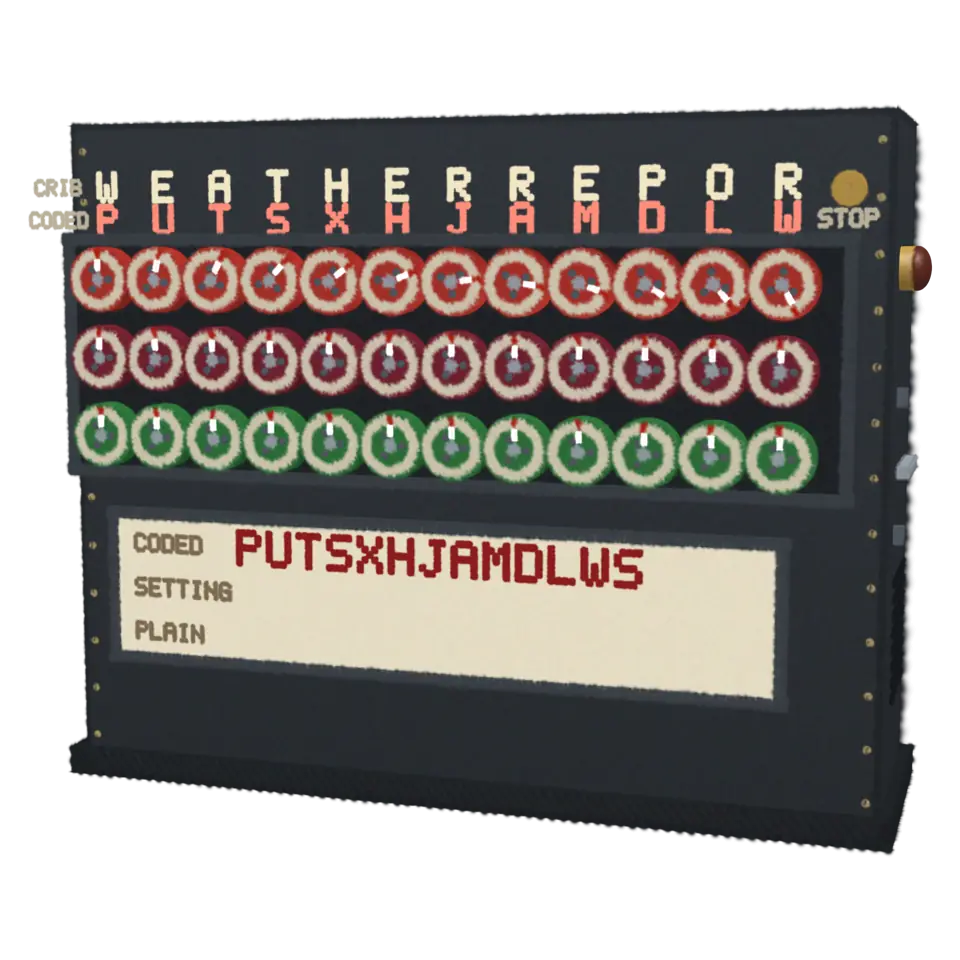
The Bombe was the codebreaking machine of Bletchley Park in England.
Play with it in the Playground
How to play
Tap it to search for the Enigma setting. Type a message to break in the Splash tab.
Toy facts
- Item
- No. 46 of 460
- Shelf
- Aisle 3, AI and Computing
- Kind
- Built from a recipe
- Small parts
- 630,000
- Your own
- A message to break
- Sound
- Yes
- Batteries
- None
- Assembly
- It does that itself
- Licenses
- Own work (made in the page)
- Price
- $0.00
Small parts are the splats in its usual build on a computer. A phone may draw fewer.
Its controls
| Control | Kind | Range | Start |
|---|---|---|---|
| Start the search | Tap | ||
| Search | Button |
About it
The Bombe was the codebreaking machine of Bletchley Park in England. Alan Turing designed it in 1939, building on a Polish machine, and Gordon Welchman added the diagonal board that made it far faster. Its rows of drums copy Enigma rotors. From a crib, a few words the codebreakers guessed were in a message, it tried rotor settings at great speed and stopped when the logic held. About 200 were built, run day and night mostly by members of the Women's Royal Naval Service, the Wrens.
Tap it: the drums spin through the settings, stop, and the lamp lights; then the message reads out. Simplified here: the plugboard is taken as known, and the drums turn far slower than the real ones.
Details
- Splats
- Opens at 200,000 at Mid Detail, 119,970 at Low, and up to 900,000 at Max
Is it right?
The splash really searches rotor starts using its Enigma calculation and stops at the first matching crib. It assumes the plugboard is known and supplies the message itself. It illustrates a search, rather than reproducing the historical Bombe’s menu and diagonal-board logic.
Correct
Turing’s 1939 design and Welchman’s diagonal board contributed to the British Bombe.1
The About attribution and approximate count of 200 machines are supported; the museum gives 202 established machines and predominantly Wrens as operators.
Correct
The splash tests rotor starting positions against a crib.23
An independent implementation agrees with the first matching setting and decrypted output for four messages, including a one-letter ambiguous crib.
Simplified
The splash simplifies the historical search.3
It knows the plugs and derives a crib of up to 12 letters from the supplied plaintext. It has no menu loops or diagonal-board deductions for unknown plugs.
Simplified
A crib match is not proof of a unique original key.3
The enumeration stops at the first matching start. Short cribs can match several settings, even when the shown plaintext is recovered.
- 1Bombe historical background, The National Museum of Computing; John Jackson
- 2How Enigma works, Crypto Museum
- 3British Bombe, Crypto Museum
- Simplified
- The plaintext is used to generate a ciphertext and its crib. Only fixed I–II–III, rings AAA, and known plugs AR GK OX are searched. It enumerates 17,576 starts and accepts the first crib match, which need not identify a unique key. Drum movement is a slowed animation rather than the search’s mechanical timing.
Sources and credits
Made in Splashery. Its code is MIT.