Aisle 6No. 93 of 460
Splashery
Attractors
630,000 small parts. Assembled in your browser.
Empty. Now look down.
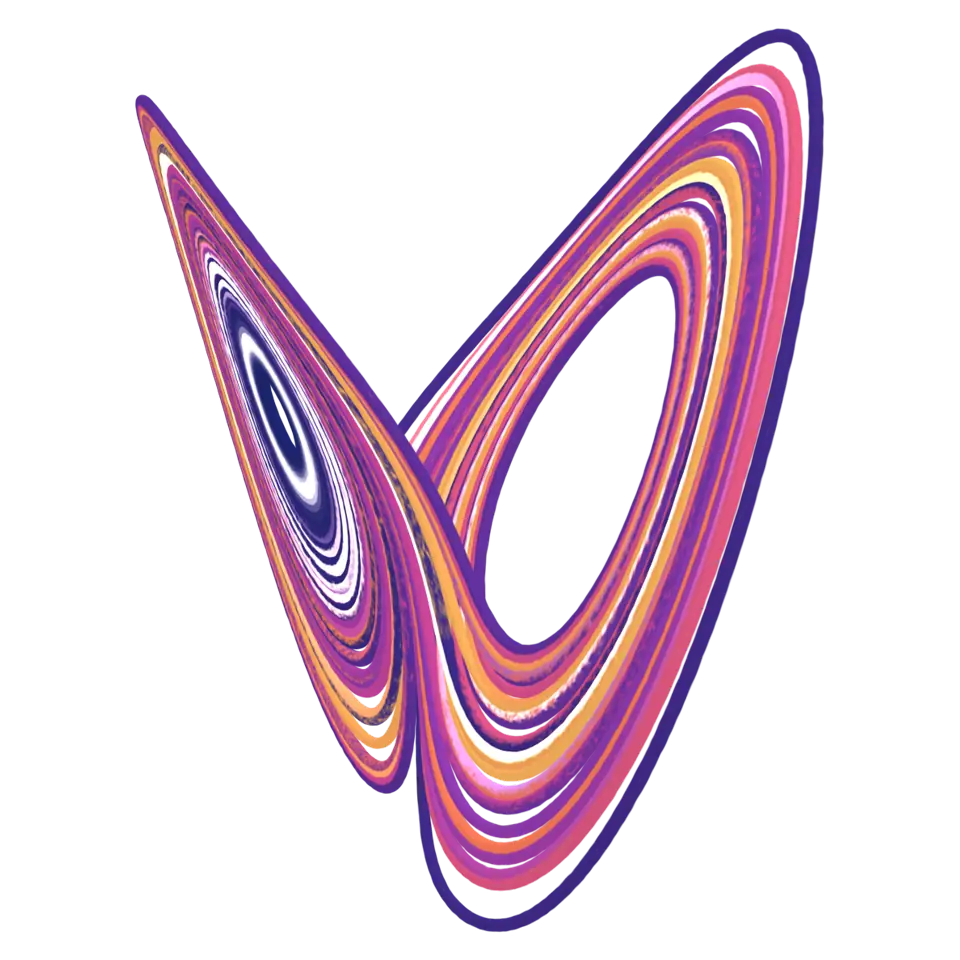
Swipe across the pack to tear it open.
Press and hold. It pulls itself together.
Let go to drop it.
It stays in its pack here. The Playground has the rest.
Math · Built from a recipe
Attractors
In 1963 the scientist Edward Lorenz made a very simple model of moving air: three short equations.
Play with it in the Playground
How to play
Tap it to race a spark round. Hands-on: drag the point to a new start; let go.
Toy facts
- Item
- No. 93 of 460
- Shelf
- Aisle 6, Math
- Kind
- Built from a recipe
- Small parts
- 630,000
- Sound
- Yes
- Hands-on
- Yes
- Batteries
- None
- Assembly
- It does that itself
- Licenses
- Own work (made in the page)
- Price
- $0.00
Small parts are the splats in its usual build on a computer. A phone may draw fewer.
Its controls
| Control | Kind | Range | Start |
|---|---|---|---|
| Race along the path | Tap | ||
| Glow | Slider | 0 to 100% | 70% |
| Race | Button |
About it
In 1963 the scientist Edward Lorenz made a very simple model of moving air: three short equations. He found that its path loops around two centers forever, never repeating and never crossing itself, in a shape like a pair of butterfly wings. This shape is called the Lorenz attractor.
Tap it and a bright spark races along the whole path, drawing it again in light that then fades. Two starting points that are almost the same soon follow very different paths. This is called chaos, or the butterfly effect, and it is why weather is so hard to forecast far ahead.
Details
- Splats
- Opens at 200,000 at Mid Detail, 60,000 at Low, and up to 900,000 at Max
Sources and credits
Made in Splashery. Its code is MIT.