Aisle 7No. 117 of 460
Splashery
Orbital Atlas
370,005 small parts. Assembled in your browser.
Empty. Now look down.
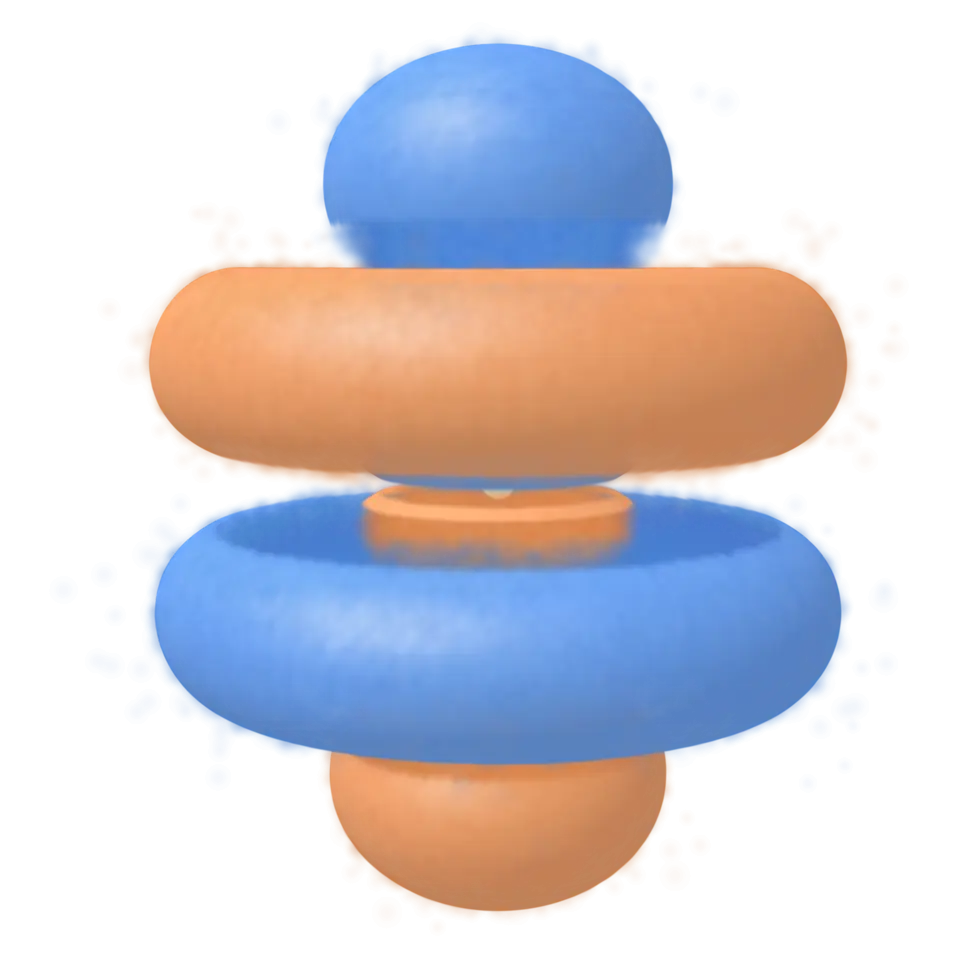
Swipe across the pack to tear it open.
Press and hold. It pulls itself together.
Let go to drop it.
It stays in its pack here. The Playground has the rest.
Atoms · Built from a recipe
Orbital Atlas
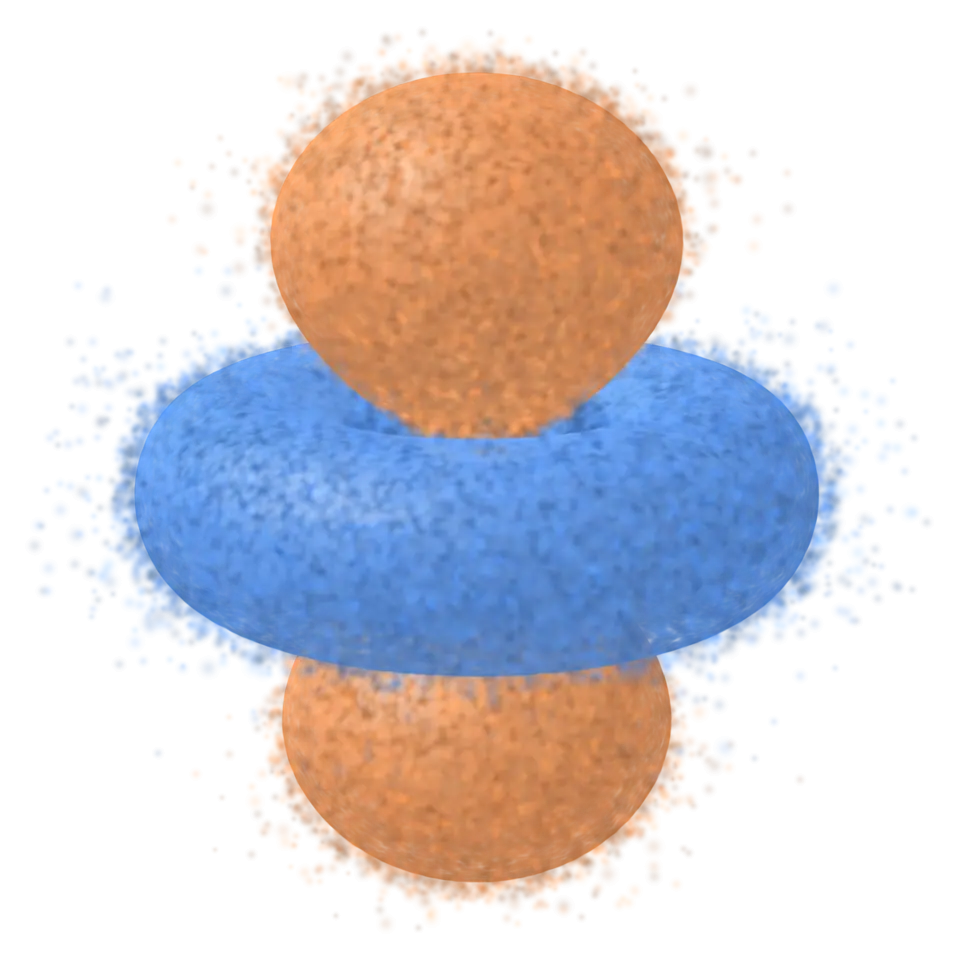
An orbital is a wave that tells where an electron in an atom is likely to be.
Play with it in the Playground
How to play
Tap to cut the orbital open and see the density inside. Pick any orbital in the Splash tab.
Toy facts
- Item
- No. 117 of 460
- Shelf
- Aisle 7, Atoms
- Kind
- Built from a recipe
- Small parts
- 370,005
- Sound
- Yes
- Batteries
- None
- Assembly
- It does that itself
- Licenses
- Own work (made in the page)
- Price
- $0.00
Small parts are the splats in its usual build on a computer. A phone may draw fewer.
Its controls
| Control | Kind | Range | Start |
|---|---|---|---|
| Cut it open | Tap | ||
| Cut open | Button | ||
| Orbital | List | 68 choices | 5f (z³) |
| Look | List | 2 choices | Cloud |
| Plus phase | Color | #ff8a3d | |
| Minus phase | Color | #3d8bff |
About it
An orbital is a wave that tells where an electron in an atom is likely to be. This atlas draws every orbital of hydrogen from the first shell to the fifth (s, p, d, f and g), plus 6s, 6p, 6d, 7s and 7p, from the exact solutions of the Schrödinger equation. The cloud shows where the electron is likely to be found; the surface holds about 90% of it. Orange and blue mark the wave's two signs.
Tap to cut the orbital in half and lift the front half away: the cut face is brightest where the electron is most often found and dark at the nodes, where it is never found. Each orbital is scaled to fill the view; real ones grow with the shell number squared.
Details
- Splats
- Opens at 200,000 at Mid Detail, 108,643 at Low, and up to 362,143 at Max
Is it right?
The atlas draws every hydrogen orbital of n = 1 to 5 and 6s, 6p, 6d, 7s and 7p from the exact hydrogen wave functions: normalized radial functions (associated Laguerre polynomials) times real spherical harmonics. Points are sampled from |ψ|² the way the Electron orbital splash samples them, colored by the sign of ψ. Tests check the radial functions against the textbook formulas, their normalization, orthogonality and node counts, the harmonics against their Cartesian forms, and the samples against the analytic distributions.
Correct
The radial functions are the hydrogen atom's R_nl.1
R_nl(r) = N (2r/n)^l e^(−r/n) L_(n−l−1)^(2l+1)(2r/n), N² = (2/n)³ (n−l−1)! / (2n (n+l)!), in Bohr radii.
Correct
The angular functions are the real spherical harmonics, named by their Cartesian forms (4d (xy), 5f (z³), 5g (x⁴−6x²y²+y⁴) …).2
Y_lm = √2 N_lm P_l^|m|(cos θ) cos(mφ) or sin(|m|φ), computed in Cartesian form as d^m P_l/dz^m times Re or Im of (x + iy)^|m|; without the Condon–Shortley sign, so each lobe's sign matches its name.
Correct
The cloud is drawn from |ψ|²: the radius from r²R², the direction from Y².
An inverse-CDF table of r²R² (cut at the 98.5% quantile, as the Electron orbital splash does) and rejection sampling against Y's largest value.
Correct
The tap's cut face shows |ψ|² in the plane of the cut, with the nodes dark.
The orbital is turned about its up axis so its densest vertical plane faces the viewer; the tap lifts the front half away, and the back half's face is an even grid on that plane, each point colored by the sign of ψ and brightened by |ψ| relative to the plane's peak.
- 1Hydrogen-like atom: the radial functions, Wikipedia
- 2Table of spherical harmonics: real spherical harmonics, Wikipedia
- Simplified
- The boundary surface is the level that holds about 90% of the electron, as in most textbooks; the cloud is cut at the radius that holds 98.5%.
- Simplified
- Each orbital is scaled to fill the view; their real sizes grow as n² (7p is about 50 times wider than 1s).
- Simplified
- Orange and blue mark the sign of ψ (its phase), which is a convention, not a color the electron has.
- Simplified
- These are hydrogen's orbitals; in heavier atoms the shapes are similar but the sizes and energies differ.
Sources and credits
Made in Splashery. Its code is MIT.