Aisle 23No. 394 of 460
Splashery
Phagocytosis
540,010 small parts. Assembled in your browser.
Empty. Now look down.
Swipe across the pack to tear it open.
Press and hold. It pulls itself together.
Let go to drop it.
It stays in its pack here. The Playground has the rest.
Tiny World · Built from a recipe
Phagocytosis
Phagocytosis means "cell eating".
Play with it in the Playground
How to play
Tap to watch the neutrophil catch and digest the bacterium.
Toy facts
- Item
- No. 394 of 460
- Shelf
- Aisle 23, Tiny World
- Kind
- Built from a recipe
- Small parts
- 540,010
- Sound
- Yes
- Batteries
- None
- Assembly
- It does that itself
- Licenses
- Own work (made in the page)
- Price
- $0.00
Small parts are the splats in its usual build on a computer. A phone may draw fewer.
Its controls
| Control | Kind | Range | Start |
|---|---|---|---|
| Catch the bacterium | Tap | ||
| Eat | Button |
About it
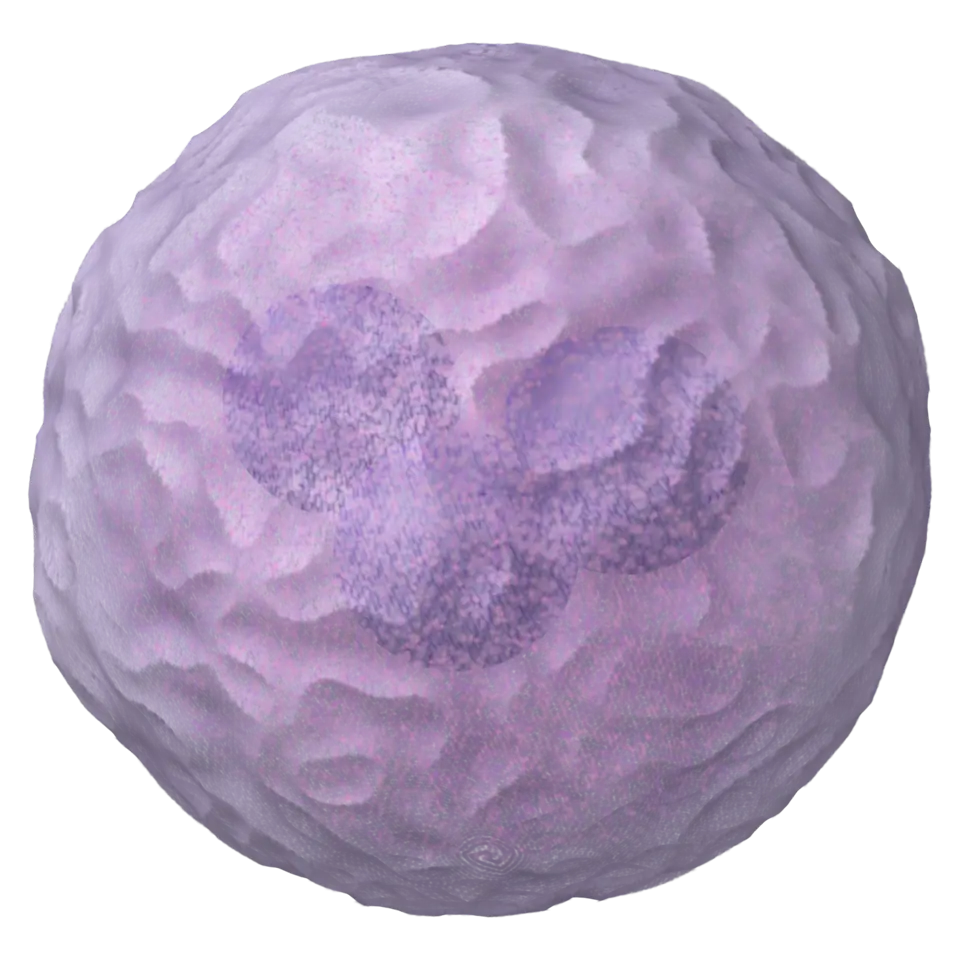
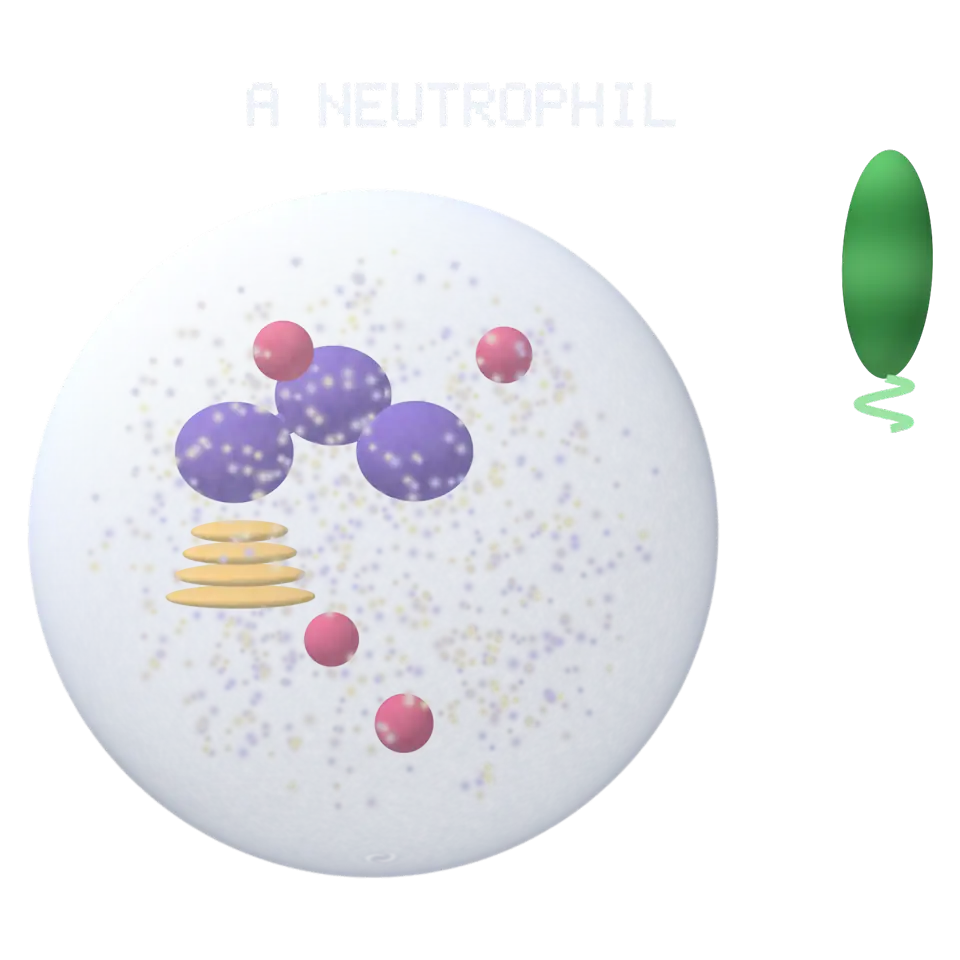
Phagocytosis means "cell eating". Tap and this neutrophil, a white blood cell, reaches out pseudopods around a bacterium until their tips meet, enclosing it in a bubble of membrane called a phagosome. Lysosomes, small sacs of digestive enzymes, fuse with it to make a phagolysosome, where the bacterium is broken down. The cell then releases the waste.
Neutrophils are the most common white blood cells; their nucleus has several lobes. A real neutrophil also kills with bursts of reactive oxygen; the splash shows the steps of eating.
Details
- Splats
- Opens at 200,000 at Mid Detail, 60,000 at Low, and up to 780,000 at Max
Is it right?
The splash shows a neutrophil eating a bacterium in the steps a microbiology textbook gives: pseudopods wrap it into a phagosome, lysosomes fuse to make a phagolysosome, it is digested and the waste is released. The cell and its parts are a clear diagram.
Correct
The phagocyte wraps the bacterium in pseudopods and pinches it off into a membrane vesicle, the phagosome.1
The membrane near the bacterium reaches round it in two layers until the opening closes; a phagosome around the bacterium is then drawn into the cell.
Simplified
Lysosomes fuse with the phagosome to form a phagolysosome, where enzymes digest the bacterium.1
Five lysosomes travel to the phagosome one after another and join it; it turns pink (a phagolysosome); the bacterium comes apart into six pieces that shrink.
Correct
The leftover waste is released from the cell.1
The phagolysosome moves to the membrane and its remains go out of the cell.
Correct
Neutrophils are the most common white blood cells, have a lobed nucleus and prefer to eat bacteria.2
The cell has a nucleus of three joined lobes.
- 1Microbiology, 17.4 Pathogen Recognition and Phagocytosis, OpenStax
- 2Anatomy and Physiology 2e, 18.4 Leukocytes and Platelets, OpenStax
- Simplified
- The bacterium swims to the cell; in the body the neutrophil also crawls toward it, following chemical signals (chemotaxis).
- Simplified
- The phagosome's acidification and the burst of reactive oxygen that neutrophils use to kill bacteria are left out.
- Simplified
- New lysosomes bud from the Golgi and a new bacterium arrives at the end, so the splash can play again.
- Simplified
- The cell is drawn about three times the bacterium's length; a real neutrophil (about 12 micrometers) is about six times a 2-micrometer bacterium.
Sources and credits
Made in Splashery. Its code is MIT.