Aisle 3No. 34 of 460
Splashery
Recurrent Network
539,996 small parts. Assembled in your browser.
Empty. Now look down.
Swipe across the pack to tear it open.
Press and hold. It pulls itself together.
Let go to drop it.
It stays in its pack here. The Playground has the rest.
AI and Computing · Built from a recipe
Recurrent Network
A recurrent network, or RNN, reads a sequence, like the words of a sentence, one piece at a time.
Play with it in the Playground
How to play
Tap it to read a sentence one word at a time. Try the LSTM style in the Splash tab.
Toy facts
- Item
- No. 34 of 460
- Shelf
- Aisle 3, AI and Computing
- Kind
- Built from a recipe
- Small parts
- 539,996
- Sound
- Yes
- Batteries
- None
- Assembly
- It does that itself
- Licenses
- Own work (made in the page)
- Price
- $0.00
Small parts are the splats in its usual build on a computer. A phone may draw fewer.
Its controls
| Control | Kind | Range | Start |
|---|---|---|---|
| Read a sentence | Tap | ||
| Read | Button | ||
| Style | List | 2 choices | Simple |
| View | List | 2 choices | Poster (2D) |
About it
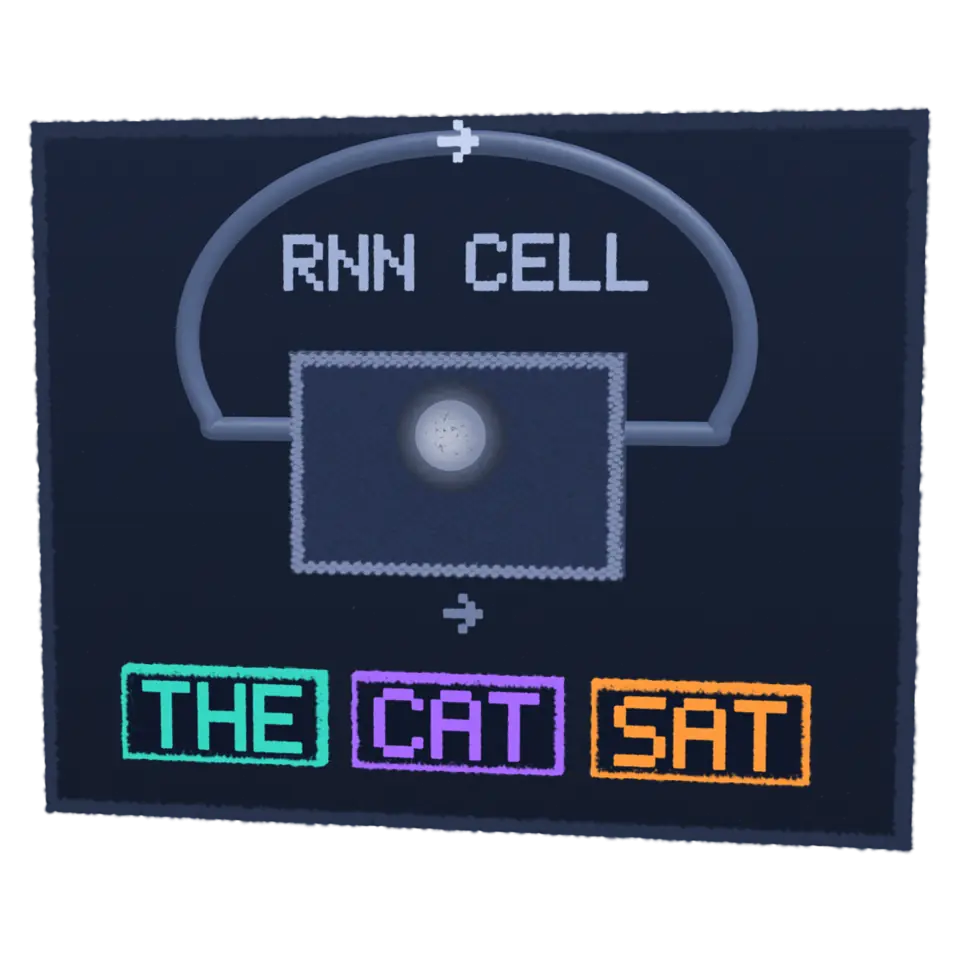
A recurrent network, or RNN, reads a sequence, like the words of a sentence, one piece at a time. It keeps a memory called the hidden state: after each word, the state loops back in with the next word, so what it knows builds up as it reads. An LSTM (long short-term memory) adds gates that decide what to forget, what to take in and what to pass on.
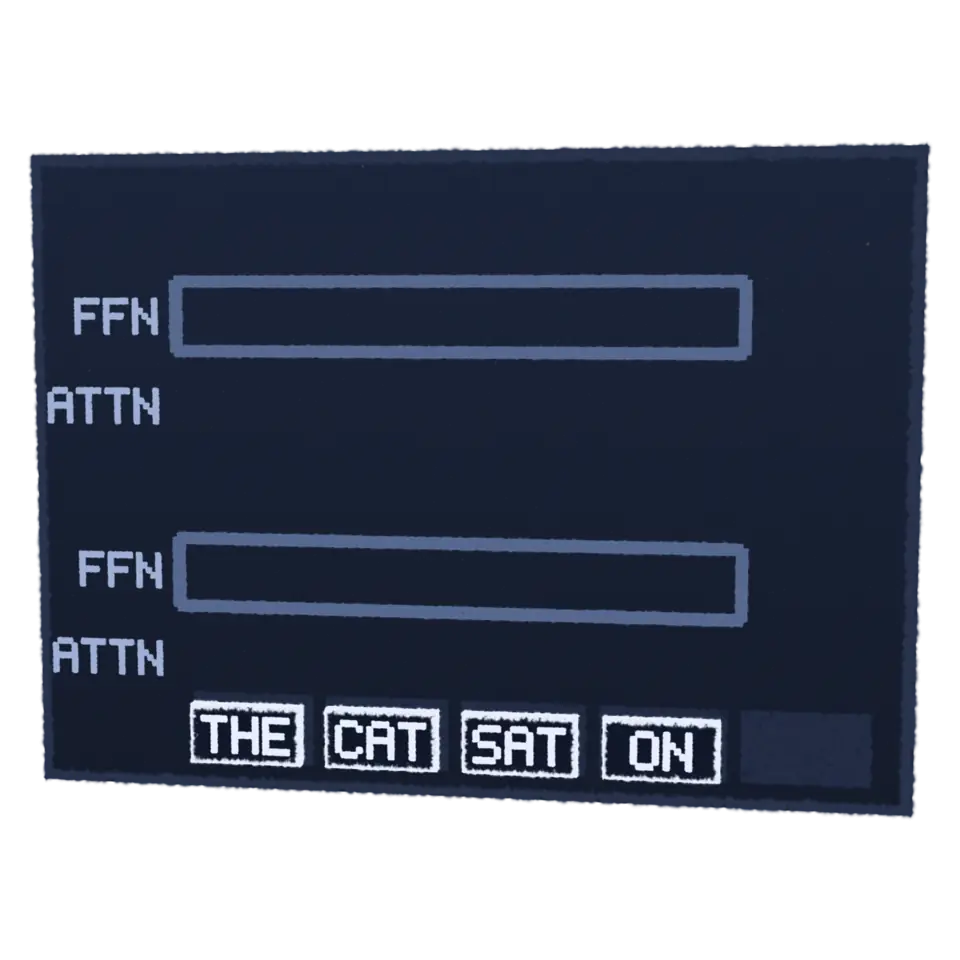
Tap it: THE, CAT and SAT rise into the cell one at a time. The cell flashes, and the glowing orb, the hidden state, takes on the word's color mixed with what it carried and runs around the loop. In the Splash tab, pick the LSTM style to see its three gates open and shut like shutters, or a 3D model. This is a scripted sequence, not a trained sentence reader.
Details
- Splats
- Opens at 200,000 at Mid Detail, 59,999 at Low, and up to 780,000 at Max
Is it right?
The diagram shows the idea of passing a hidden state through a sequence. Its colors and LSTM shutters are scripted, and it has no learned recurrent weights or numerical cell state.
Simplified
An RNN carries a hidden state from one sequence item to the next.1
The diagram loops an orb between THE, CAT, and SAT, matching the flow of a recurrent state.
Correct
An LSTM uses forget, input, and output gates.2
The three shutter labels are F, I, and O, matching those gate roles.
Simplified
The splash illustrates gate operation without reading a sentence.12
The colors and shutters are stored animation values. The About text explicitly calls this a scripted sequence.
- 1Recurrent neural networks, Dive into Deep Learning authors
- 2Long short-term memory, Dive into Deep Learning authors
- Simplified
- THE CAT SAT, the orb colors, and the gate openings repeat a stored sequence. The LSTM view has no numerical cell-state update or sigmoid gate values.
Sources and credits
Made in Splashery. Its code is MIT.