Aisle 5No. 85 of 460
Splashery
Real Star Systems
5,152 small parts. Assembled in your browser.
Empty. Now look down.
Swipe across the pack to tear it open.
Press and hold. It pulls itself together.
Let go to drop it.
It stays in its pack here. The Playground has the rest.
Space · Built from a recipe
Real Star Systems
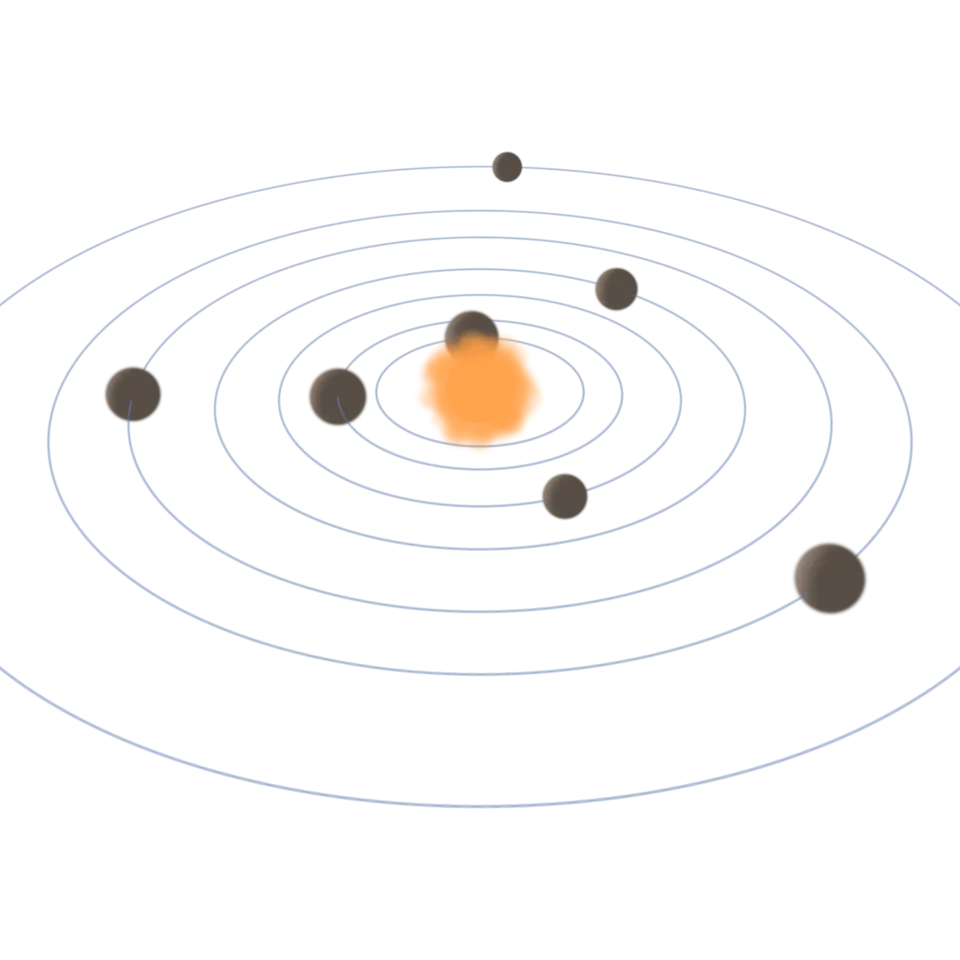
Real planets round other stars, from the NASA Exoplanet Archive: TRAPPIST-1, a cool red dwarf 40 light-years away with seven rocky planets, all closer to it than Mercury is to the Sun; TOI-178, whose six planets go round in a chain of near-simple ratios; and 55 Cancri, with a planet whose year is shorter than a day.
Play with it in the Playground
How to play
Tap to see it edge on, as from Earth. Pick a system, speed and spacing in the Splash tab.
Toy facts
- Item
- No. 85 of 460
- Shelf
- Aisle 5, Space
- Kind
- Built from a recipe
- Small parts
- 5,152
- Made from
- Real planetary systems from the NASA Exoplanet Archive: the orbits' sizes and periods are measured; the star and the planets are drawn much larger than the orbits' scale, and the planets' colors are not known (they show their size class).
- Sound
- Yes
- Batteries
- None
- Assembly
- It does that itself
- Licenses
- CC0
- Price
- $0.00
Small parts are the splats in its usual build on a computer. A phone may draw fewer.
Its controls
| Control | Kind | Range | Start |
|---|---|---|---|
| Turn it to the view from Earth and back | Tap | ||
| See it from Earth | Button | ||
| System | List | 4 choices | TRAPPIST-1 |
| Speed | List | 3 choices | A day each second |
| Distances | List | 2 choices | To scale |
About it
Real planets round other stars, from the NASA Exoplanet Archive: TRAPPIST-1, a cool red dwarf 40 light-years away with seven rocky planets, all closer to it than Mercury is to the Sun; TOI-178, whose six planets go round in a chain of near-simple ratios; and 55 Cancri, with a planet whose year is shorter than a day. The inner Solar System is there to compare.
The orbits' sizes and periods are measured, and the planets move at those rates, sped up. Star and planets are drawn far larger than to scale. Nobody knows these planets' colors, so they show their size: gray-brown for rocky, blue for mid-sized, tan for giants. Tap to see the system edge on, as we see TRAPPIST-1 and TOI-178: their planets were found as they passed in front of their stars.
Is it right?
Real planetary systems from the NASA Exoplanet Archive: each planet's orbit size and period are the archive's, and the planets go round at those rates, sped up as labeled. The star's and the planets' sizes are enlarged and their colors unknown, and the splash says both.
Correct
The planets' orbit sizes, periods and radii are the NASA Exoplanet Archive's composite values.1
tools/sp2-systems.mjs reads them from the archive's Planetary Systems Composite Parameters table through its TAP service.
Correct
Each planet goes once round its star in its measured period (sped up by the chosen factor).2
The drive adds the elapsed days over each planet's period to its angle; the test checks the angles after 12 days.
- 1NASA Science Data License, NASA
- 2Planetary Systems table columns, NASA Exoplanet Archive
- Simplified
- The star and the planets are drawn far larger than the orbits' scale (said in the splash).
- Simplified
- Orbits are drawn as circles in one plane; the real ones are very slightly oval and tilted a little to each other.
- Simplified
- The planets' colors are not known; they are colored by size class (said in the splash).
- Simplified
- Each planet starts at an arbitrary place on its orbit, not where it is today.
- Simplified
- Spread out (not to scale) places the orbits by the square root of their sizes.
Sources and credits
| Work | By | License |
|---|---|---|
| NASA Exoplanet Archive, Planetary Systems Composite Parameters | NASA Exoplanet Science Institute (Caltech/IPAC) | CC0 (NASA mission data) |