Aisle 3No. 37 of 460
Splashery
Diffusion Model
629,982 small parts. Assembled in your browser.
Empty. Now look down.
Swipe across the pack to tear it open.
Press and hold. It pulls itself together.
Let go to drop it.
It stays in its pack here. The Playground has the rest.
AI and Computing · Built from a recipe
Diffusion Model
A diffusion model makes pictures out of noise.
Play with it in the Playground
How to play
Tap it: the noise clears, step by step, into a rubber duck.
Toy facts
- Item
- No. 37 of 460
- Shelf
- Aisle 3, AI and Computing
- Kind
- Built from a recipe
- Small parts
- 629,982
- Sound
- Yes
- Batteries
- None
- Assembly
- It does that itself
- Licenses
- Own work (made in the page)
- Price
- $0.00
Small parts are the splats in its usual build on a computer. A phone may draw fewer.
Its controls
| Control | Kind | Range | Start |
|---|---|---|---|
| Denoise | Tap | ||
| Denoise | Button | ||
| View | List | 2 choices | Poster (2D) |
About it
A diffusion model makes pictures out of noise. It is trained by taking real pictures, adding random noise to them a little at a time until only specks are left, and learning to undo each step. To make a new picture, it starts from pure noise and takes a little away at each of many steps, until a clear picture appears.
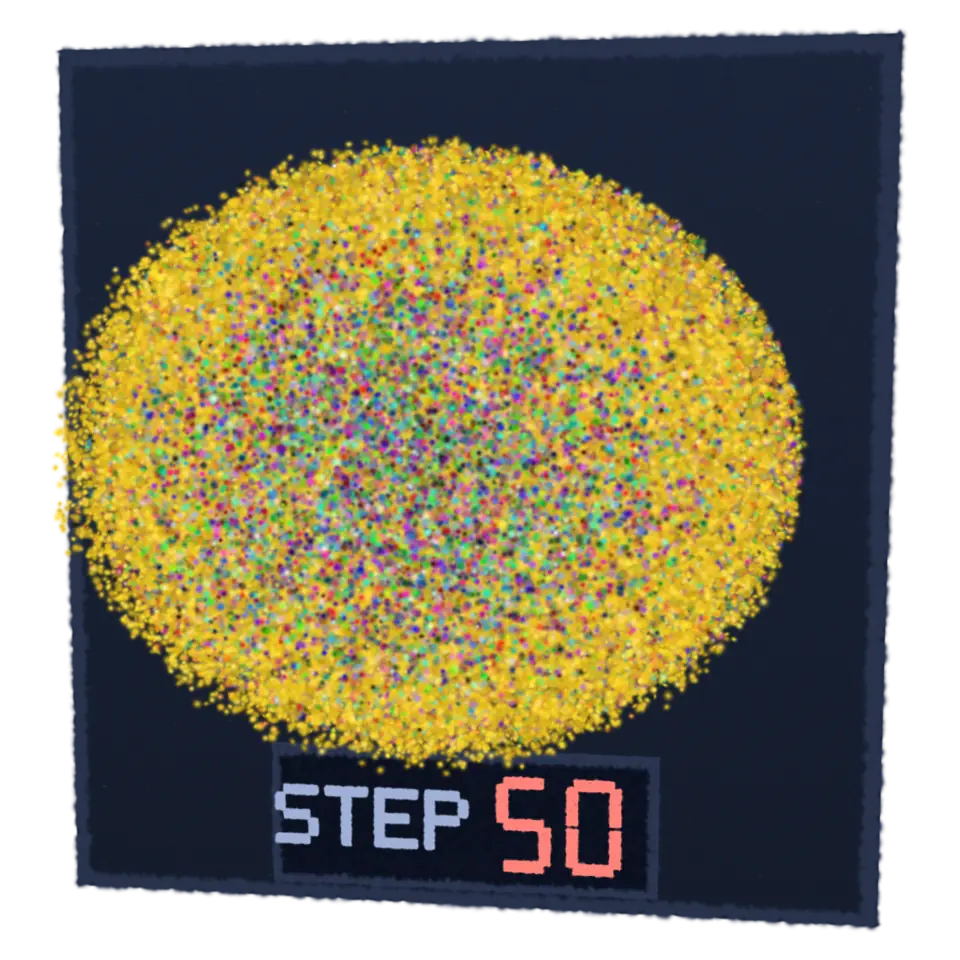
Tap it: a cloud of random specks clears in ten steps into a rubber duck while the STEP counter runs down from 50 to 0, then the noise washes back over it. Pick the poster or a 3D model in the Splash tab.
Details
- Splats
- Opens at 200,000 at Mid Detail, 59,998 at Low, and up to 999,967 at Max
Is it right?
The About text describes the broad idea of learning to reverse a noise process. The splash morphs a fixed noise cloud into a known duck in ten stages; its 50-to-0 counter is a visual scale, not 50 calculated denoising steps.
Correct
Diffusion generation uses a learned reverse noise process.1
The About text gives an introductory description of adding noise for training and reversing it to generate a picture.
Simplified
The splash has ten visual stages while the counter goes from 50 to 0.1
The stage helper selects ten morph values and the actual display reports 50 minus five times the stage.
Simplified
The clearing duck is a prepared illustration of generation.1
The morph blends fixed particle positions toward a known duck. No model predicts the noise to remove.
- 1Denoising Diffusion Probabilistic Models, Ho, Jain, and Abbeel, 2020
- Simplified
- The duck is supplied in advance and there is no denoising network, training objective, or sampled reverse process. Ten visual stages decrease the counter by five each time.
Sources and credits
Made in Splashery. Its code is MIT.